Life Cycle Assessment of Buildings (LCA)
Contact our Sustainability expertsComprehensive building Life Cycle Assessment (LCA), quantifying environmental impacts from material production and construction through operation to end of life, while providing a robust basis for design optimization, BREEAM and LEED certification, EU Taxonomy alignment and EPBD requirements.
A building’s environmental footprint is no longer determined by its operation alone. An ever-growing share of the impacts consists of embodied carbon - the emissions embedded in materials, construction and future renovations - and it is precisely these that investors, certification schemes and European legislation are focusing on. Life Cycle Assessment (LCA) is an internationally standardized method that quantifies these impacts across the building’s entire life cycle: from raw material extraction through material manufacturing, transport, and construction to the use stage and the end of the building’s life. At Grinity, we prepare building LCAs in accordance with EN 15978 and EN 15804+A2, on a cradle-to-grave basis — always with a clear outcome: where the impacts arise, how to reduce them and how to use the results for certifications, the EU Taxonomy and upcoming legislative requirements.
What does LCA measure?
The methodological framework of LCA is defined by the international standards ISO 14040 and ISO 14044; for buildings, it is specified by the European standard EN 15978, which divides the life cycle into modules: A (product manufacturing and the construction process), B (use, maintenance and replacements), C (end of life - demolition and waste management) and D (potential benefits beyond the system boundary, for example from the reuse and recycling of materials). Our input data comes primarily from databases of Environmental Product Declarations (EPD) prepared in accordance with EN 15804+A2.
And it is not just about carbon. Alongside global warming potential (GWP), LCA quantifies further environmental impact categories - such as acidification, eutrophication or stratospheric ozone depletion - giving you a complete picture of how the building burdens the environment. Together with the operational carbon footprint, embodied emissions then make up the building’s complete whole life carbon.
How We Work
The calculation is based on the design documentation and the bill of quantities; from it, we take the actual quantities of materials and structures, so the results reflect your project rather than generic estimates. We carry out the calculation in One Click LCA - an internationally established building LCA software with an extensive EPD database, accepted for the LCA credits of both BREEAM and LEED.
The output is a clear quantification of impacts by individual life cycle module and impact category, expressed per m² of floor area, complemented by a hotspot analysis: which structures and materials contribute most to the impacts and where optimization would have the greatest effect. The earlier in the design process you commission an LCA, the more room you have for these decisions.

LCA in BREEAM and LEED Certification
Whole-building LCA is now firmly embedded in both major certification schemes. In BREEAM, it is the subject of credit Mat 01 (environmental impacts from construction products - building life cycle assessment), which requires an assessment in accordance with EN 15978 and evaluates further mandatory indicators alongside GWP. In LEED v4 BD+C, it is the MR “Building Life-Cycle Impact Reduction” credit: its whole-building LCA path awards up to 3 points (plus exemplary performance) for demonstrating at least a 10% reduction in impacts against a baseline building in at least three of six impact categories. We prepare the documentation for both schemes to stand up to certification review.
LCA in European Legislation – the EU Taxonomy and the EPBD
LCA is ceasing to be a voluntary discipline. For the construction of new buildings with a floor area over 5,000 m², the EU Taxonomy requires, as part of its substantial contribution criteria, the calculation of the life-cycle GWP for each stage of the life cycle and its disclosure to investors and clients on demand — as a numeric indicator in kgCO2e/m² of useful internal floor area, averaged over 50 years of the building’s life.
The new Energy Performance of Buildings Directive EPBD (EU) 2024/1275 goes further still: from 1 January 2028, the whole life-cycle GWP must be calculated and disclosed in the energy performance certificate of new buildings with a useful floor area over 1,000 m², and from January 2030 for all new buildings. A harmonized Union calculation framework is already in place — adopted by the Commission as Delegated Regulation (EU) 2026/52. Those who have their building’s LCA prepared today already hold the data and methodology the legislation will require.

What You Receive
- A building LCA study in accordance with EN 15978 on a cradle-to-grave basis, including module D
- Results by life cycle module and impact category expressed per m² of floor area — in a format ready for certifications, the EU Taxonomy and ESG reporting
- A hotspot analysis identifying the structures and materials with the largest share of impacts, with recommendations for reducing them
- Documentation for the credits BREEAM Mat 01 and LEED MR “Building Life-Cycle Impact Reduction”
- Evidence for the EU Taxonomy and the upcoming EPBD requirements on life-cycle GWP reporting
Planning a new building or a major renovation? Get in touch with us - we will be happy to discuss, with no obligation, at what project stage and in what scope an LCA makes the most sense for your development.
Other Sustainability services
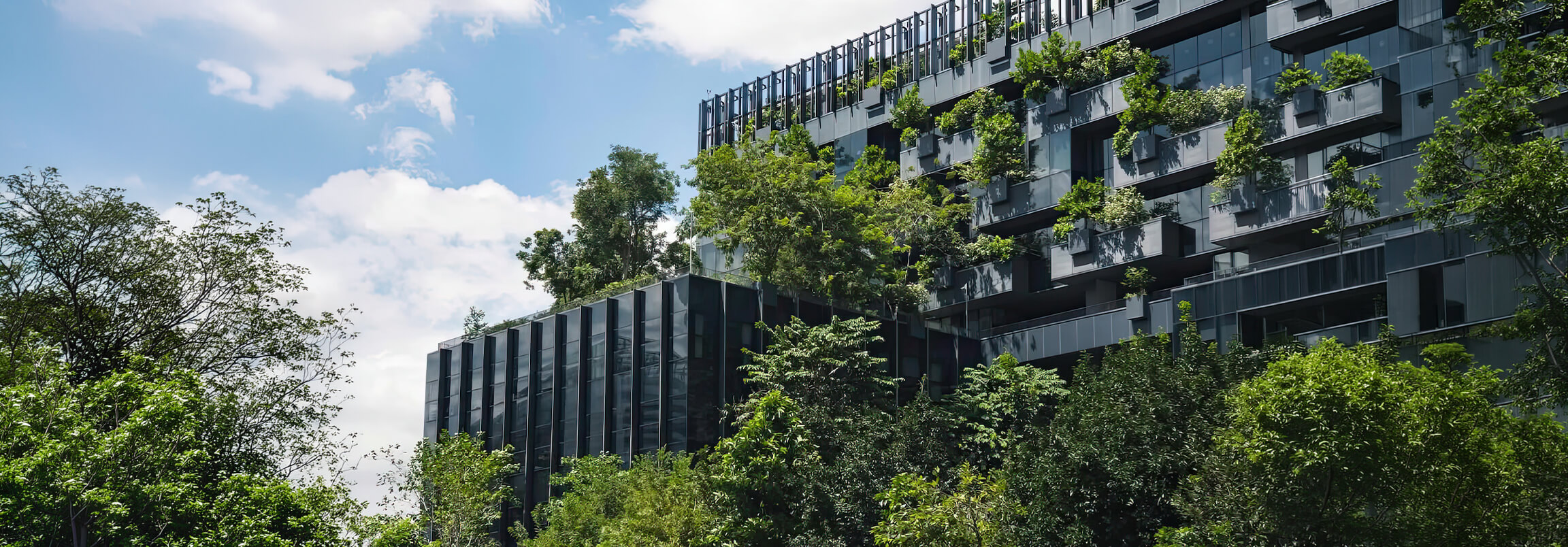
BREEAM Certification
Comprehensive BREEAM assessment and certification across new construction, refurbishment, in-use and community projects, helping buildings demonstrate sustainability throughout their entire lifecycle.
Detail BREEAM Certification
LEED Certification
Full LEED certification support for new builds, fit-outs and/or existing buildings, guiding projects to internationally recognized standards in energy, water, materials and indoor quality.
Detail LEED Certification
WELL Certification
Comprehensive WELL consultancy and certification for new and existing buildings, helping to create healthier, more comfortable and higher-quality indoor environments while demonstrating building quality from the perspective of occupants’ wellbeing.
Detail WELL Certification
ESG Advisory
We help companies and real estate portfolios navigate ESG strategy, risk management and reporting with confidence – from ESG Due Diligence to data collection and outputs that support financing, compliance and long-term asset value.
Detail ESG Advisory
Thermographic Assessment
Comprehensive building thermography and thermal diagnostics, helping to identify heat loss and hidden construction defects, optimise energy performance and reduce long-term operating costs while improving indoor comfort and overall building quality.
Detail Thermographic Assessment
WELL Performance Testing
WELL Performance Verification and Testing provide objective data on indoor environmental quality and confirm whether well-being strategies work effectively in practice. As the first accredited WELL Performance Testing Provider in the CZ, we deliver professional on-site testing for certification and recertification.
Detail WELL Performance Testing
GRESB Assessment
GRESB is the leading investor-driven international benchmark for the ESG performance of real estate portfolios and funds, assessed annually. We guide you through the entire cycle – data collection, gap analysis and submission – with support from a GRESB AP credential holder.
Detail GRESB AssessmentOur Sustainability references



Contact our Life Cycle Assessment of Buildings (LCA) experts
Ask our experts directly!